
Figures as of November 2026. Every figure is linked to its published source; figures marked MCA calculation are our arithmetic on those sources.
Data center cost in 2026: building a modern data center in the US and Canada costs an average of $17.6 million per megawatt all in, excluding chips and GPUs, with costs up 21 percent per MW since the previous edition of its guide in late 2024, according to Cushman & Wakefield, which is why the decisions made before design locks, the subject of data center consulting, carry so much weight. Leasing the same capacity cost about $196 per kilowatt per month for a 250 to 500 kW requirement in primary North American markets at the end of 2025, according to CBRE, and rates rose a further 4.3 percent in the first half of 2026, with the steepest increases on the large requirements covered in wholesale colocation. Running a data center is dominated by power: the industry's average PUE is 1.52, barely changed in seven years. And for AI and GPU deployments, the hardware inside can cost far more than the building: an eight-GPU H100 server runs $250,000 to $320,000, and a GB200 NVL72 rack about $3 million to $4 million all in, by the most recent estimates, which is why many teams compare buying against renting first.
What Are You Pricing?
Leasing data center space
What a cabinet, a kilowatt and a cross-connect cost by market, and what larger leases run.
Building or developing a facility
What a site can serve, what a specification costs, and how to get power on a date.
AI and GPU capacity
Where high-density racks fit, what GPUs rent for, and what rack-scale systems cost.
Leaving your own data center or the cloud
What it costs to move, and where the workloads should go next.
Data Center Costs: Quick Answers
How much does a data center cost to build?
About $17.6 million per MW for the most modern greenfield facilities in the US and Canada, excluding chips and GPUs.
How much does a data center cost per watt?
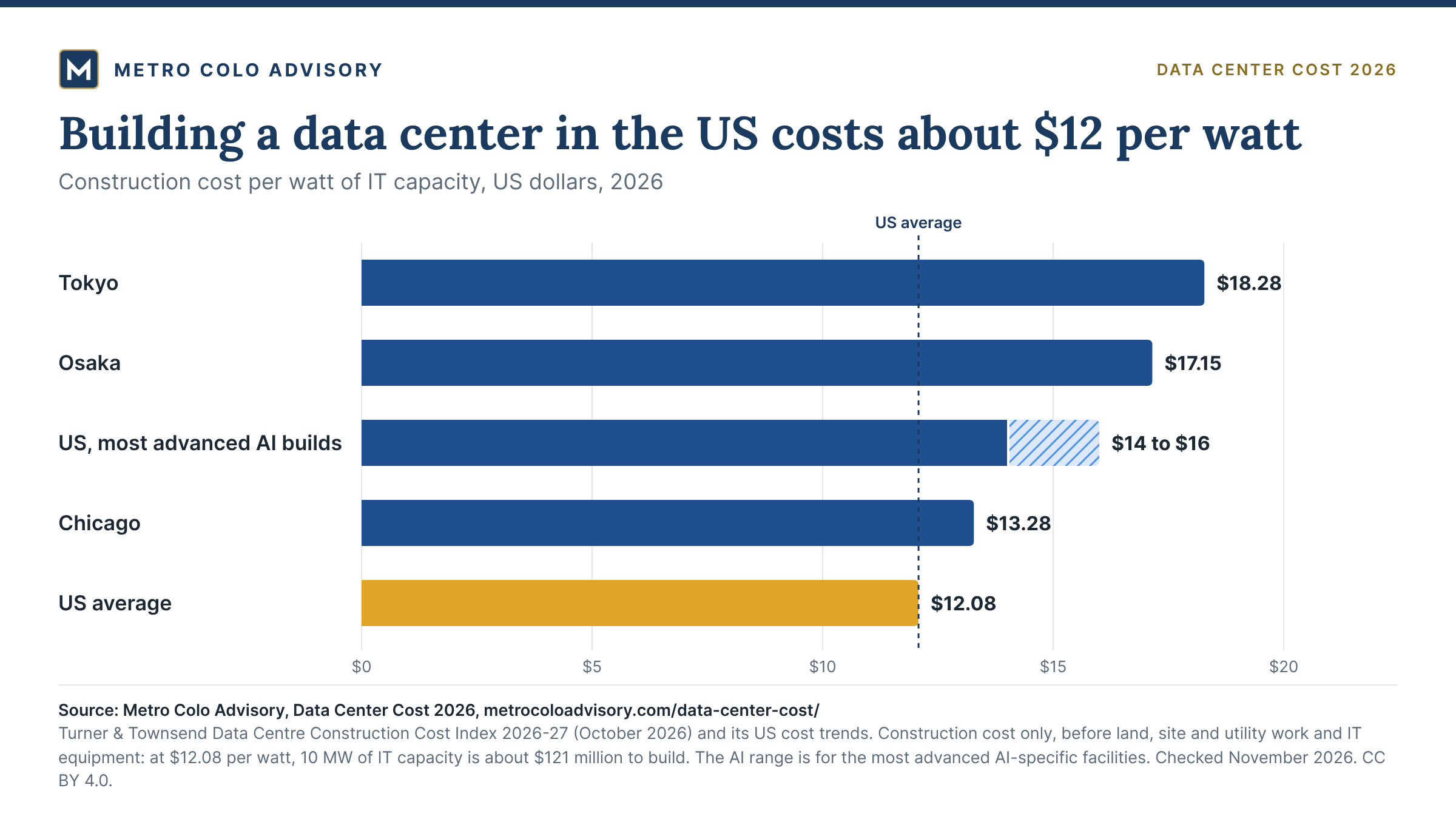
US$12.08 per watt on average to build in the US, and US$14 to $16 per watt for the most advanced AI-specific facilities.
How much does an AI data center cost?
AI-ready data centers cost 7 to 10 percent more to build than traditional data centers of similar IT capacity in the US (November 2025), and around 10 percent in the 2026-27 index.
How much does colocation cost per kW?
About $196 per kW per month for 250 to 500 kW at the end of 2025, about $204 by mid-2026 by our estimate.
How much electricity do data centers use?
192 TWh in 2024, 4.7 percent of US electricity, projected at about 11.8 percent by 2030, within a range of 9.5 to 15.3 percent.
How much water do data centers use?
About 66 billion liters directly in 2023, roughly 17.4 billion gallons, 84 percent of it in hyperscale facilities.
How much does a colocation cabinet cost?
Retail rates run about $350 to $1,400 per kW per month in the New York metro, so a 5 kW cabinet starts around $1,750 to $2,000 a month at the low end of the range, before cross-connects and setup.
How much does it cost to power 1 MW?
About $1.3 million a year at the July 2026 US average industrial rate of 9.77 cents per kWh and the average PUE of 1.52; large-load tariffs differ by utility.
Is it cheaper to build or lease?
At 2026 averages, leasing 1 MW for about seven years costs roughly what building it does, before operating costs: a rough ratio, not a break-even.
How Much Does It Cost to Build a Data Center?
Construction cost is quoted per megawatt of IT capacity, or per watt, which is the same number divided by a million. The two most-cited benchmarks measure different things: Cushman & Wakefield's figure is all in, including land and site work; Turner & Townsend's index covers construction only.
Source: Turner & Townsend Data Centre Construction Cost Index 2026-27 and US cost trends, October 2026. Free to cite with a link to this page.
| Figure | Number | Source |
|---|---|---|
| All-in greenfield development cost, US and Canada | $17.6 million per MW, excluding chips and GPUs | Cushman & Wakefield, 2026 |
| Change in cost per MW since the previous edition (late 2024) | +21 percent | Cushman & Wakefield |
| Change in North American and European construction cost per watt, 2026-27 index | +13 percent year on year across North American and European markets; global average +6 percent | Turner & Townsend, 2026-27 |
| Construction cost inflation, traditional data centers, 2025 | 5.5 percent, down from 9.0 percent in 2024 | Turner & Townsend |
| Premium for AI data centers, US | 7 to 10 percent over traditional data centers of similar IT capacity; around 10 percent in the 2026-27 index | Turner & Townsend, November 2025 |
| Average project cost per square foot | $960 in the 12 months to November 2025, up from $534 | ConstructConnect, via Quartz |
| Powered land, primary US markets | $584,000 per MW in 2026 to date, up 51 percent | Cushman & Wakefield |
| Average US data center land cost | $5.59 per square foot, about $244,000 per acre, 2024 | Cushman & Wakefield, via Quartz |
Where the money goes. Electrical systems (utility service, switchgear, UPS and generators) are typically the largest single category of construction cost, followed by mechanical and cooling. Liquid cooling shifts more of the budget into mechanical systems, which is where the AI premium comes from. Redundancy is the other big swing: a Tier IV facility runs about $5 million to $8 million more per megawatt to build than Tier III, as our data center tiers guide breaks down. For developers and investors deciding what to build, the data center consulting practice covers feasibility, specification and operator fit, and the powered shell and build to suit guides cover the two main development structures.
At $17.6 million a megawatt, the expensive decisions are made before design locks: how much IT load the power actually supports, what the building should be, and who will lease it. A feasibility study answers that in writing, at a fixed fee, before capital is committed. You’ll hear back within 24 hours.
How Much Does It Cost to Lease Data Center Capacity?
Most companies lease rather than build. Tenant pricing is quoted per kilowatt of committed power per month, and in 2026 the larger the requirement, the faster its price is rising: the volume discounts large tenants used to count on have narrowed or disappeared in the tightest markets.
Source: CBRE North America Data Center Trends H1 2026. Free to cite with a link to this page. Interactive version, with PNG and data download.
| Figure | Number | Source |
|---|---|---|
| Average asking rate, 250 to 500 kW, primary markets | $195.94 per kW per month at end of 2025, up 6.5 percent, the fourth straight annual rise | CBRE, H2 2025 |
| Change in that rate, first half of 2026 | +4.3 percent, nearly double the rise a year earlier | CBRE, H1 2026 |
| Implied rate, mid-2026 | About $204 per kW per month | MCA calculation from the two CBRE figures |
| Retail colocation, New York metro | About $350 to $1,400 per kW per month; a 5 kW cabinet from about $1,750 to $2,000 a month at the low end | Metro Colo Advisory pricing guide, market estimate |
| Rent increase on renewals at Digital Realty, Q3 2026 | +11.8 percent on a cash basis, +17.0 percent on a GAAP basis (Q2 2026: +25.4 percent cash) | Digital Realty Q3 2026 results |
| Cross-connect, per connection | Roughly $100 to $300 a month, plus setup | OSH, IPTP |
| Remote hands | Roughly $150 to $350 an hour, higher after hours, with minimums | IPTP, OSH |
Send us the requirement: power, cabinets or megawatts, location and date. You'll hear back within 24 hours. We find the facilities that fit, benchmark them against what comparable deployments pay and, for a move, build a five-year comparison with the move included. Placement costs you nothing; the provider you choose pays us.
Requirements of 1 MW and up, and the lease terms that protect a tenant at renewal, are covered in wholesale colocation.
How Much Does It Cost to Run a Data Center? Power, PUE and Water
Once built, a data center's largest ongoing cost is electricity: the power for the IT equipment plus the overhead to cool it and distribute power, which is what PUE measures. At the global average PUE of 1.52, every dollar of power used by IT equipment carries about 52 cents of overhead.
Source: Berkeley Lab, United States Data Center Energy Usage Report: 2025 Update, June 2026, for the US Department of Energy. Free to cite with a link to this page.
| Figure | Number | Source |
|---|---|---|
| Average data center PUE worldwide | 1.52 in 2026, in line with a seven-year trend of relative stasis | Uptime Institute, 2026 |
| Direct water consumption, US, 2023 | About 66 billion liters, about 17.4 billion gallons | Berkeley Lab, via DCD; gallons are an MCA calculation |
| Share of that water used by hyperscale facilities | 84 percent | Berkeley Lab, via DCD |
| Projected hyperscale water use, 2028 | 60 to 124 billion liters | Berkeley Lab, via DCD |
| Direct water consumption, 2014 | 21.2 billion liters | Berkeley Lab, via DCD |
How Much Does It Cost to Power a Data Center?
The electricity bill for 1 MW of IT load depends on two numbers: the price per kilowatt-hour and the facility's PUE. US industrial customers paid an average of 9.77 cents per kWh in July 2026, the newest month available, according to the EIA, though large data centers negotiate their own tariffs, and rates range from about 6 cents in Texas and Louisiana to more than 20 cents in California and New England. The harder number is usually how much utility power a site can actually get connected, which is what our AI Power Reality Check tracks against what has been requested.
MCA calculation: 8,760 MWh times PUE times $97.70 per MWh. Sources: EIA Monthly Energy Review, October 2026, Table 9.8; Uptime Institute. Free to cite with a link to this page. Interactive version, with PNG and data download.
A $514,000 a year swing per megawatt from PUE alone, and rates from 6 cents to 20 cents a kWh by state, decide whether a site pencils. A feasibility study tests the power, the tariff and the design against those numbers in writing, at a fixed fee, before capital is committed. You’ll hear back within 24 hours.
Power density. Average rack density across the industry is rising slowly, concentrated in racks of 10 to 30 kW, and racks above 100 kW remain rare, according to the Uptime Institute. Its 2026 survey finds about a quarter of operators (24 percent) now report some racks at 30 kW or above, up from 19 percent in 2025 (Uptime Institute, 2026). AI is the exception: current rack-scale GPU systems draw roughly 120 kW per rack and up, and need direct-to-chip liquid cooling. The AI and GPU colocation guide covers which facilities can host them, including the direct-to-chip cooling they need.
How Much Does AI Hardware Cost?
For AI deployments, the equipment inside the building costs far more than the building. These are published market ranges; GPU prices move quickly, so check the date.
| Item | Price | Source |
|---|---|---|
| NVIDIA H100 GPU | $25,000 to $40,000 | GPU Smith, July 2026 |
| Eight-GPU HGX H100 server | $250,000 to $320,000 | CloudZero, August 2026 |
| NVIDIA B200 GPU | About $40,000 to $45,000 | GPU Smith, July 2026 |
| Eight-GPU HGX B200 server | About $390,000 | GPU Smith, July 2026 |
| GB200 NVL72 rack, 72 GPUs | About $3.1 million bare and $3.9 million all in; other estimates from $2 million | SemiAnalysis, August 2025; other estimates GPU Smith, July 2026 |
| GB300 NVL72 rack, 72 GPUs | About $3.7 million to $4 million, estimated | GPU Smith, July 2026 |
| Renting an H100, per GPU-hour | $2.89 to $6.98 on demand, depending on provider | CloudZero, October 2026 |
| Median on-demand H100 rate, specialist GPU clouds | About $3.25 per GPU-hour; AWS about $6.88 | Metro Colo Advisory GPU rental tracker, September 2026 |
| Typical on-demand H100 rate | About $3.17 per GPU-hour, $25.36 for an eight-GPU server (median of 78 on-demand prices) | SAVRN GPU price tracker, Nov. 14, 2026 |
MCA calculation from the figures above. Over three years, owning an eight-GPU H100 server and colocating it at the low end of New York retail rates costs about $411,000 ($285,000 to buy plus about $3,500 a month for 10 kW), or about $450,000 if power is billed on top. Renting the same eight GPUs around the clock costs about $666,000 at the typical $3.17 an hour, or about $683,000 at the $3.25 specialist-cloud median. Owning stays cheaper unless hosting runs above roughly $1,000 per kW a month. Owning wins when the hardware runs most of the time; renting wins for short or variable work, and reserved terms from specialist GPU clouds sit in between. Free to cite with a link to this page.
For renting rather than buying, the GPU rental guide has current on-demand and reserved prices across the specialist GPU clouds and hyperscalers, and where reserved terms land against on-demand rates.
Data Center TCO: Building Versus Leasing 1 MW
Using only the published averages on this page: building 1 MW costs about $17.6 million up front, excluding servers, while leasing it costs about $2.45 million a year plus metered power. The lines cross after about seven years. Seven years of rent equals the build cost, a rough ratio rather than a break-even: the build figure leaves out staff, maintenance, financing and the years spent waiting for power. It is an illustration, not a quote; real projects vary widely by market, density and term.
MCA calculation from Cushman & Wakefield and CBRE figures. Free to cite with a link to this page.
Why most companies lease
Seven years is longer than most will commit to one site, the builder still carries operating costs and risk after year seven, and a lease avoids a two to four year wait for power. Wholesale colocation covers leasing at scale.
When building pays
At large scale, over long horizons, where power is already secured. That decision, and the specification that decides who can ever lease the building, is what data center consulting covers, including due diligence on an existing facility you are thinking of buying.
When neither is the question
For steady workloads now in the public cloud, the comparison that matters is cloud against colocation or bare metal. See cloud repatriation.
Connectivity and Cloud Costs
| Figure | Number | Source |
|---|---|---|
| AWS internet egress, US regions | About $0.09 per GB for the first 10 TB a month, falling in tiers to about $0.05 above 150 TB | AWS data transfer pricing |
| AWS Direct Connect data transfer out, US | About $0.02 per GB, roughly 78 percent below first-tier internet egress | AWS Direct Connect pricing |
| AWS Direct Connect dedicated port | About $219 a month at 1 Gbps, $1,643 at 10 Gbps | AWS Direct Connect pricing |
| Data transfer into AWS | Free | AWS |
In practice, a company sending 200 TB a month out of AWS to its own data center would pay about $13,800 a month over the internet and about $5,600 over a private link, before partner fees (MCA calculation). At that volume, the private link saves several times its own port fee, and egress is one of the line items a cloud repatriation plan has to price. Cutting the cloud bill without moving is covered in FinOps consulting.
Data Center Capacity and Market Figures
| Figure | Number | Source |
|---|---|---|
| Vacancy, primary North American markets, H1 2026 | 1.4 percent, a record low | CBRE, H1 2026 |
| Vacancy, Northern Virginia | 0.2 percent | CBRE |
| Total supply, primary markets | 10,903 MW, up 33.7 percent | CBRE, H1 2026 |
| Capacity under construction, primary-market colocation, H1 2026 | 7,481 MW, up 24.8 percent, a record | CBRE, H1 2026 |
| Construction already preleased | 80.4 percent, up from 74.3 percent | CBRE, H1 2026 |
| Future capacity still available, primary markets | Under 1,500 MW, about six months of demand | CBRE, H1 2026 |
| Net absorption, primary-market colocation, H1 2026 | 1,456 MW, up nearly 12 percent | CBRE |
| All of North America, including hyperscale self-builds, H1 2026 | About 25 GW absorbed, 66 GW under construction | JLL, H1 2026 |
| Largest construction market | Atlanta, nearly 2,900 MW under construction | CBRE |
| Global development pipeline | $2.3 trillion, $492 billion under construction | Cushman & Wakefield, Sept. 2026 |
The CBRE rows count colocation space in primary markets only. The JLL row counts all of North America, including hyperscale self-builds. What those numbers mean for a buyer: with most new capacity preleased before it is built, the time to start a search is well before the need. For an investor, they are why due diligence now starts with power and tenant demand rather than the building, and why a powered shell with its power already secured is worth more than an empty one. For leasing at scale, see wholesale colocation.
How Long Does It Take?
Sources: CBRE US Real Estate Outlook 2026; Wood Mackenzie, via Data Center Knowledge; Digital Realty; Dominion IRP, via WTVR; CBRE Chicago, H2 2025. Transformer weeks converted to months (MCA calculation).
| Stage | Typical time | Source |
|---|---|---|
| New power interconnection for large campuses | 24 to 48 months or more for a large campus. In constrained grids the dates run much later: Dominion listed about 25 GW of large-load requests as of February 2026, including data center projects, with projected connection dates through 2031, and CBRE reports ComEd projects face delivery delays until 2032 or later | CBRE, Dominion IRP, via WTVR, CBRE Chicago |
| Substation transformer lead time | More than 160 weeks in 2026, up from about 140 in 2023 | Wood Mackenzie, via DCK |
| Construction of a sub-50 MW building | Traditionally 12 to 18 months, a range CBRE says no longer holds as campuses grow | CBRE |
| Lease signing to rent commencement | 17 months, weighted average, Digital Realty Q3 2026 | Digital Realty |
| Projects blocked or delayed by local opposition, Q1 2026 | At least 75 projects, about $130 billion | Data Center Watch |
| Projects blocked or delayed by local opposition, Q2 2026 | At least 45 projects, nearly $68 billion | Data Center Watch |
Power, equipment and permission, not construction, now set most timelines. Roughly $200 billion of projects were blocked or delayed by local opposition in the first half of 2026 alone (MCA calculation, adding Data Center Watch's two quarters). That is why preleasing reaches into 2027 and beyond, and why the consulting practice spends as much time on power as on buildings.
In Texas, Senate Bill 6 (signed June 20, 2025) requires interconnection standards for new ERCOT loads of 75 MW or more, including a study fee of at least $100,000, disclosure of on-site backup generation, and an ERCOT study and PUCT decision before a new large load can net meter with an existing power plant. In grid emergencies ERCOT can direct those loads to run their backup generation or curtail, and transmission-voltage loads connected after 2025 must have equipment that allows curtailment during firm load shed. Utilities also ask for money before they build: the PUCT rule implementing the law, effective October 8, 2026, requires security of $50,000 per MW of requested peak demand (PUCT), and Evergy's large load plan in Kansas requires collateral equal to two years of minimum monthly bills (Kansas Corporation Commission). More terms by utility are in our data center electric rates tracker.
With power, transformers and local approval setting the schedule, the questions that decide a deal come before the building: what the site can actually serve, when, and who will lease it. We answer them in writing, at a fixed fee agreed before work starts, and deal details stay confidential.
Embed This Chart
Free to use on your site, in articles and in reports under CC BY 4.0. Copy the code below; it keeps the credit and the link to this page.
Download the Data and How to Cite It
Every figure on this page is published as an open dataset: CSV files with the value, unit, period and source link for each figure, under a permanent DOI. Writers, analysts and researchers are welcome to use any figure or chart, with credit to Metro Colo Advisory and a link to this page.
| File | What it holds | Rows | Download |
|---|---|---|---|
| All cost figuresdata-center-cost-figures.csv | Every figure on this page with its value, unit, period, source link and whether it is an MCA calculation | 57 | Download CSV |
| Power cost by PUEdata-center-power-cost-by-pue.csv | Annual cost to power 1 MW of IT at PUE 1.0, 1.2, 1.52 and 1.8, at the July 2026 EIA industrial rate | 4 | Download CSV |
| Construction cost per wattdata-center-construction-cost-per-watt.csv | Construction cost per watt for the US average, AI-specific facilities and selected markets, 2026-27 index | 5 | Download CSV |
| Lease rate change by sizedata-center-lease-rate-change-by-size.csv | Change in asking rates by requirement size, H1 2026 | 5 | Download CSV |
| Data dictionarydata-center-cost-data-dictionary.txt | What every column means, plus the limits of the data | n/a | Download |
Also on Zenodo. License: CC BY 4.0.
Method. Figures come from the published sources linked beside each one and were checked in October 2026 and updated November 14, 2026. Figures marked MCA calculation are our arithmetic on those sources. The page and the data files are updated each quarter as new reports are released, as a new version under the same DOI. For a figure behind a specific requirement, or a comment on the record, contact us.
The public file is free to use under CC BY 4.0. For a custom cut by market, operator or date, scheduled updates, email us what you are working on. If it is a site, a deal or a lease, the same research backs our data center consulting.
Frequently Asked Questions
How much does a data center cost?
A modern greenfield data center in the US and Canada costs an average of $17.6 million per megawatt all in, excluding chips and GPUs, according to Cushman & Wakefield's 2026 guide. A 10 MW facility therefore costs about $176 million before any IT equipment.
What is the data center construction cost per MW?
Construction alone averages about $12.1 million per MW in the US, according to Turner & Townsend's 2026-27 index, and $14 million to $16 million per MW for the most advanced AI-specific facilities. All-in development cost, including land and site work, averages $17.6 million per MW.
How much does an AI data center cost?
AI-ready data centers cost 7 to 10 percent more to build than traditional data centers of similar IT capacity in the US, according to Turner & Townsend, and its 2026-27 index puts the premium at around 10 percent. The GPUs inside cost far more than the building: a single GB200 NVL72 rack runs about $3 million to $4 million all in, by the most recent estimates.
What is the data center cost per square foot?
The average data center project cost $960 per square foot in the 12 months to November 2025, up from $534 a year earlier, according to ConstructConnect data reported by Quartz. Per-megawatt figures are more useful for comparing data centers, because density varies so much.
How much does it cost to lease data center space?
About $196 per kW per month for a 250 to 500 kW requirement in primary North American markets at the end of 2025, according to CBRE, rising 4.3 percent in the first half of 2026. At about $204 per kW, 1 MW costs roughly $2.45 million a year before metered power.
How much does a colocation cabinet cost per month?
Retail colocation in the New York metro runs about $350 to $1,400 per kW per month depending on the building, so a 5 kW cabinet starts around $1,750 to $2,000 a month at the low end of the range, before cross-connects, setup fees and remote hands. Those are asking rates; negotiated rates usually land below them.
How much does it cost to power a data center?
About $1.3 million a year per megawatt of IT load at the July 2026 US average industrial rate of 9.77 cents per kWh and the average PUE of 1.52, an MCA calculation from EIA and Uptime Institute figures. A modern facility at PUE 1.2 costs about $1.03 million; an older one at 1.8 about $1.54 million. Large data centers negotiate their own tariffs, and rates vary from about 6 cents per kWh in Texas to more than 20 cents in California.
Is it cheaper to build or lease a data center?
At 2026 averages, leasing 1 MW for about seven years costs roughly what building it does, before the builder's operating costs, a rough ratio rather than a break-even. That is why most companies lease: seven years is longer than most will commit to one site, and a lease avoids a two to four year wait for power. Building pays at large scale, over long horizons, where power is secured.
What are the main data center operating costs?
Power is the largest, including the overhead measured by PUE, which averages 1.52. Others include staffing, maintenance, water, insurance and connectivity. For tenants, the main recurring costs are the per-kW rate, metered power, cross-connects and remote hands.
How much water does a data center use?
US data centers directly consumed about 66 billion liters of water in 2023, roughly 17.4 billion gallons, according to Berkeley Lab. Hyperscale facilities accounted for 84 percent. Use varies widely with cooling design and climate.
How much electricity do data centers use?
US data centers used 192 TWh in 2024, 4.7 percent of US electricity, according to Berkeley Lab's 2025 update for the Department of Energy. Its reference case for 2030 is 649 TWh, or 11.8 percent of US electricity, within a range of 9.5 to 15.3 percent.
What is a good PUE for a data center?
The worldwide average is 1.52, according to Uptime Institute's 2026 survey, and it has barely moved in seven years. Lower is better: 1.0 would mean every watt goes to IT equipment, so newer facilities are usually judged against that average, and the best new builds run around 1.2.
Is it cheaper to rent or buy GPUs?
For hardware that runs most of the time, buying usually wins: one eight-GPU H100 server costs about $411,000 over three years to own and host at the low end of New York retail colocation rates, or about $450,000 if power is billed on top, against about $666,000 to rent on demand around the clock at the typical $3.17 per GPU-hour, or about $683,000 at the specialist-cloud median of $3.25. Owning stays cheaper unless hosting runs above roughly $1,000 per kW a month. For short or variable work, renting or a reserved term wins.
Why are data center costs rising?
Power availability, supply chain constraints for electrical and cooling equipment, skilled labor shortages and AI demand. Cushman & Wakefield reports costs up 21 percent per MW since its previous edition in late 2024, and CBRE reports vacancy at a record low 1.4 percent.
Can I download this data center cost data?
Yes. Every figure on this page is available as free CSV files under CC BY 4.0, with a permanent DOI, each row linked to its source. See Download the Data above. Please credit Metro Colo Advisory with a link to this page.
Pricing an Actual Requirement?
Published averages tell you the market. They do not tell you what a specific building will quote for your requirement, or whether your site or acquisition holds up. There are two ways we help, and you'll hear back within 24 hours either way.
Colocation, wholesale, GPU and bare metal: we find the space that fits, benchmark it against what comparable deployments pay, and negotiate the terms before you sign. Free to you; the provider you choose pays us.
Feasibility studies, build-versus-lease analysis, acquisition due diligence and market studies, delivered in writing at a fixed fee agreed before work starts.
Leasing: wholesale colocation for 1 MW and up.
AI: AI and GPU colocation and GPU rental.
Leaving the cloud: cloud repatriation, moving steady workloads from the public cloud into colocation or bare metal.
Building and investing: data center consulting, powered shell and build to suit.